
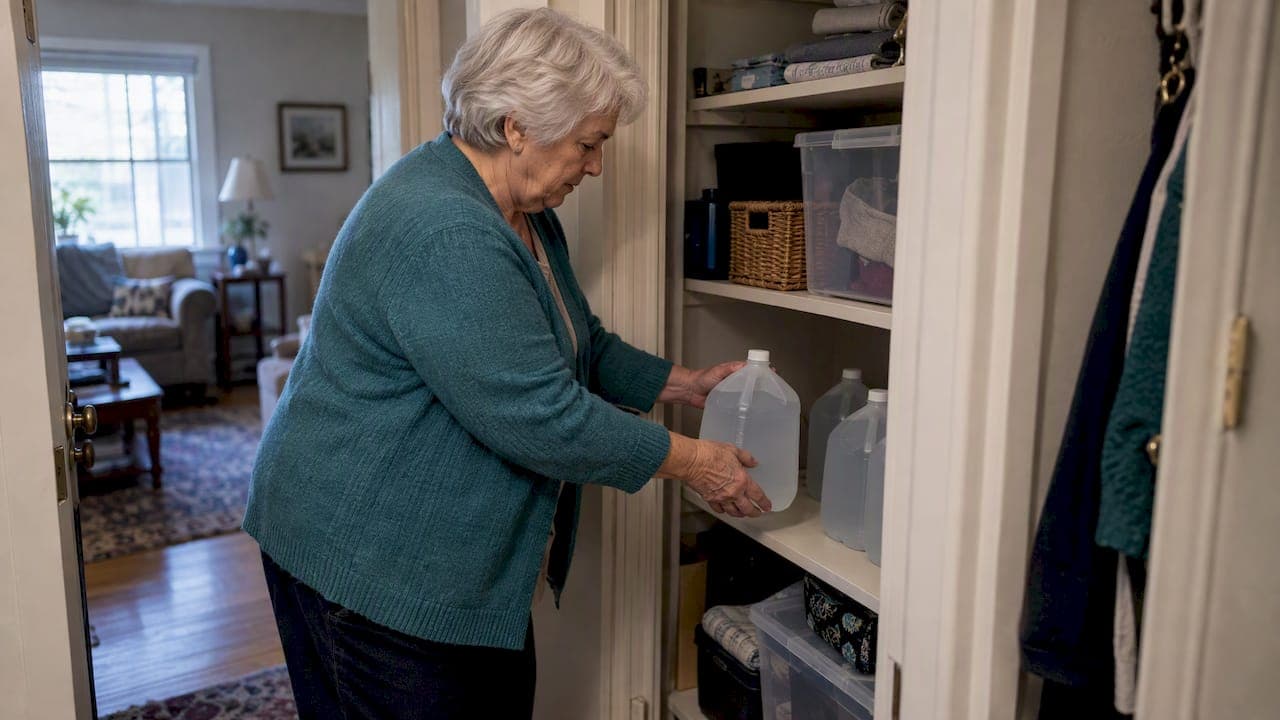
Picture a quiet Tuesday evening. You've got soup on the stove and a favorite show queued up. Then you turn the tap, and it sputters, coughs, and goes still. A main has broken somewhere down the street. Nobody is in the next room to say, "Well, that's annoying."
That small moment is where living alone can feel a little heavier than you expected. It doesn't have to. A few jugs in a closet turn "now what?" into "fine, I'll make tea." Emergency water storage for seniors isn't about fear. It's about being the kind of person who can shrug at a broken water main and carry on with the evening.
This guide covers how much to keep, what to keep it in, and how to fit it into a life you actually enjoy.
TL;DR
- Plan on at least 1 gallon per person, per day, for 3 days. Two weeks is better if you have the space. Because you're one person, that's a small, doable amount.
- Choose containers you can lift and pour comfortably. Several 1- to 2-gallon jugs beat one giant tank.
- Count water for washing and flushing, not only drinking. Those uses drain a supply faster than thirst does.
- Don't ration when the water stops. Drink what you need and stay cool.
- Pair the refresh with something you already do twice a year, so it never becomes a worry.
Table of Contents
- Why a small stash feels so good
- How much water is enough for one person
- Choosing containers that work with your hands
- Where to put it so you'll actually use it
- When the water really does stop
- Making it part of a bigger, easier plan
- A refresh that feels like a ritual
- Our perspective
- If you'd like someone to think it through with you
- Frequently asked questions
- Sources
Why a small stash feels so good
Most water advice is written for a family of four. You might have read it and thought, "That's a lot of jugs for one person." It isn't. Solo living has a quiet advantage here: your math is simple, your space needs are modest, and nobody else's preferences are involved.
What changes when you live alone is the margin. There's no one to run to the store while you rest, and no one to carry heavy bottles up the steps. So the point of storing water isn't to prepare for the worst. It's to keep your evenings, your routines, and your independence yours, even when the tap has other ideas.
There's a small pleasure in it, too. Opening a closet and seeing your own steady supply is a calm, grown-up kind of confidence.
How much water is enough for one person
The federal guidance is consistent. Ready.gov and the CDC both say to store at least 1 gallon of water per person, per day, for at least 3 days. The CDC adds that you should try for a 2-week supply if you can. The FDA's hurricane season guidance repeats the one-gallon minimum.
That gallon is meant to cover drinking, cooking, and brushing your teeth. Here is what that looks like for you:
| Supply length | Gallons for one person | What it feels like |
|---|---|---|
| 3 days | 3 | A couple of cases of small bottles, or three jugs |
| 1 week | 7 | A shelf in a closet |
| 2 weeks | 14 | The bottom of a pantry or a spot under a bed |
Treat those numbers as a floor. The CDC says to consider storing more if you live in a hot climate or if you're sick. If you live somewhere with long summers, or you take medication that you've been told requires extra fluids, build in extra.
Drinking is only part of the picture
Here's what surprises people. That single gallon has to stretch across hydration, a bit of food prep, and keeping clean. In a longer outage, the water you use for washing up and flushing the toilet disappears much faster than the water you drink.
So many solo agers keep two stashes in their heads: drinking water, which is bottled or carefully stored, and everything else water, which can be tap water in clean tubs or buckets, filled before service stops if you get warning. Keeping those apart protects the water you'll actually sip.
What about your own hydration needs?
The National Institute on Aging notes that fluid needs vary with size, activity level, and climate. It also says that if you have a condition such as heart disease or kidney problems that limits how much fluid you should have, your own doctor is the person to ask. So if you've been given a fluid limit, ask your healthcare provider how that applies in an emergency, and plan your stored amount around the answer, not around a generic number.
If you want the everyday side of this, we've written about hydration and senior health, including why thirst isn't always a reliable signal as we get older.
Choosing containers that work with your hands
The most useful storage advice we've seen is also the least glamorous: store water in containers you can move. Utah State University Extension points out that manageable 1- to 2-gallon containers are often more practical than one huge tank, because they're easier to carry, rotate, and pour. A 55-gallon drum is wonderful until you can't lift anything out of it.
Think about your own body on a bad day. Can you pour from it with one hand? Can you carry it from the closet to the counter? If not, go smaller.
The simplest option: store-bought
The CDC says that unopened, commercially bottled water is the safest and most reliable emergency source. It's sealed, it's ready, and you don't have to clean or fill anything. For many people living alone, a few cases of gallon jugs or smaller bottles is the entire plan, and that's a perfectly good plan.
A mix works nicely. Gallon jugs for the long haul, plus a few small bottles by the bed and in your bag for when you don't want to lift anything at all.
If you'd rather fill your own
The CDC advises food-grade containers for water you store yourself. Avoid milk jugs and glass bottles, and never reuse containers that once held bleach, pesticides, or other chemicals. Milk jugs are hard to clean fully and tend to break down, and glass can shatter.
Tap water you store in home-cleaned containers should be refreshed about every six months. Plastic is porous, and stored water changes over time, so a fresh fill keeps it tasting like water and not like a basement.
The freezer trick that earns its keep
Here's a favorite for people who like a two-for-one. Fill clean, freezer-safe containers and freeze them. They're an emergency water supply, and they're also a "cold bank." If the power goes out, frozen containers help your fridge and freezer stay cold longer. The USU Extension food storage booklet notes that you need to leave 2 to 3 inches of headspace so the water has room to expand and the container doesn't split.
If an outage worries you for food reasons too, our piece on what to keep or toss after a power outage walks through those decisions calmly.
Where to put it so you'll actually use it
Water you can't reach isn't water. A few easy rules of thumb:
- Keep it low and close. A bottom shelf in the kitchen or hall closet beats the top of the garage shelves.
- Spread it out. One case in the kitchen, one in a bedroom closet. If one spot is blocked, the other isn't.
- Keep it cool and out of sunlight. Heat and light are not kind to plastic.
- Keep it away from chemicals. Not next to gasoline, paint, or cleaning supplies.
That's the whole system. No spreadsheet required.
When the water really does stop
Here is something worth knowing in advance, because it takes pressure off. Ready.gov says authorities advise against rationing water unless officials explicitly tell you to. The better approach is to cut down on losses: stay cool, take it easy physically, and drink what you need. Trying to stretch your supply by drinking less raises the risk of dehydration.
So if the taps run dry, you don't need to count sips. Drink normally. Use your "everything else" water for washing. Keep your cool, literally: close the curtains on a hot afternoon, sit with a book, and let your supply do its job.
If you're an older adult, remember that the signs of dehydration, such as dry mouth, dizziness, or a racing heart, can creep up, and thirst may not warn you. If you feel unwell, call your doctor or local emergency services rather than waiting it out.

Making it part of a bigger, easier plan
Water is one piece of a broader picture. The FEMA guide for older adults encourages you to think about what you rely on every day and how you'd cover that if it stopped. That's a friendlier way to look at it than a stockpile list. It's about your routines.
For some people, the thing that makes the plan feel solid is the home itself. If you're thinking about how technology can make home life easier as you age, this practical aging-in-place plan for smart homes is a thoughtful starting point. It's written by a Canadian company, so product availability may differ in the U.S.
And if you want the wider view, these pages from our own library pair well with this one:
- A 72-hour power outage plan for solo seniors covers light, warmth, and staying in touch.
- Calm emergency drills show how to rehearse so you feel capable, not rattled.
- An emergency contact plan helps the people who care about you know how to reach you, and how you'd reach them.
A refresh that feels like a ritual
The six-month refresh is the part people forget, so don't rely on memory. Tie it to something you already do twice a year. Many solo agers pick the days the clocks change, and set a recurring calendar alert on their phone for those dates.
Make it pleasant. Put on music. Pour the older water onto the porch plants or the garden. Fill the jugs fresh. Then reward yourself with a coffee on the porch. Ten minutes, twice a year, and then you're done.

If you freeze water, the same day works for swapping the containers. If you only buy bottled water, check the dates on the labels then and use the oldest first.
Our perspective
We started Aging Solo Today because a solo life can be a full one: friendship, adventure, good meals, long walks, and plenty of joy. We've noticed that practical topics like water storage are where people tend to lose that thread. They read about emergencies and begin to feel small.
We'd like to flip that. A stash of water in a closet is not a sign that you're bracing for disaster. It's a sign that you intend to keep living the way you like, whatever the weather does. And you don't need to be an expert. A few jugs, one afternoon, and a reminder twice a year is plenty.
We also believe the best plan is one that fits your body, your home, and your budget, not a plan copied from someone else. If that means ten small bottles instead of a barrel, good. That's your plan, and it works.
— Mike Crawford
If you'd like someone to think it through with you
Sometimes it helps to talk your whole situation over with someone who gets it. Our Solo Aging Clarity Session is a 45-minute Zoom conversation, $97 one time, where we look at your own home, your own routines, and the support you'd like around you. Water is a small part of it. Mostly it's about helping you feel settled.
If you'd rather start on your own, our free resources and our guide to living alone emergency planning are there for you.
Frequently asked questions
How much water should one senior store?
Store at least 1 gallon per day for at least 3 days, which is 3 gallons for one person. The CDC suggests aiming for 2 weeks if you can, which is 14 gallons. Store more if you live in a hot climate or are ill.
What is the safest container for storing water?
The CDC calls unopened, commercially bottled water the safest and most reliable choice. If you fill your own, use food-grade containers and avoid milk jugs, glass bottles, and anything that once held chemicals. Smaller containers of 1 to 2 gallons are easier to lift and pour.
How long can stored water last?
Sealed commercial bottled water can be kept until the date on its label. For tap water in containers you cleaned yourself, plan to replace it about every six months. Setting a recurring phone reminder makes that easy.
How much water should a 70-year-old drink in a day?
There's no single number, because needs vary with size, activity, climate, and health. The National Institute on Aging says to ask your own healthcare provider, especially if you have heart or kidney conditions that limit how much fluid you should have. Your doctor can give you a figure that fits you.
Sources
- Water | Ready.gov
- How to Create an Emergency Water Supply | CDC
- Hurricane Season: Be Prepared | FDA
- 15 Tips to Keep Your Bladder Healthy | National Institute on Aging
- Storing Water | USU Extension
- Food Storage Booklet | USU Extension
- Disaster Preparedness Guide for Older Adults | Ready.gov