
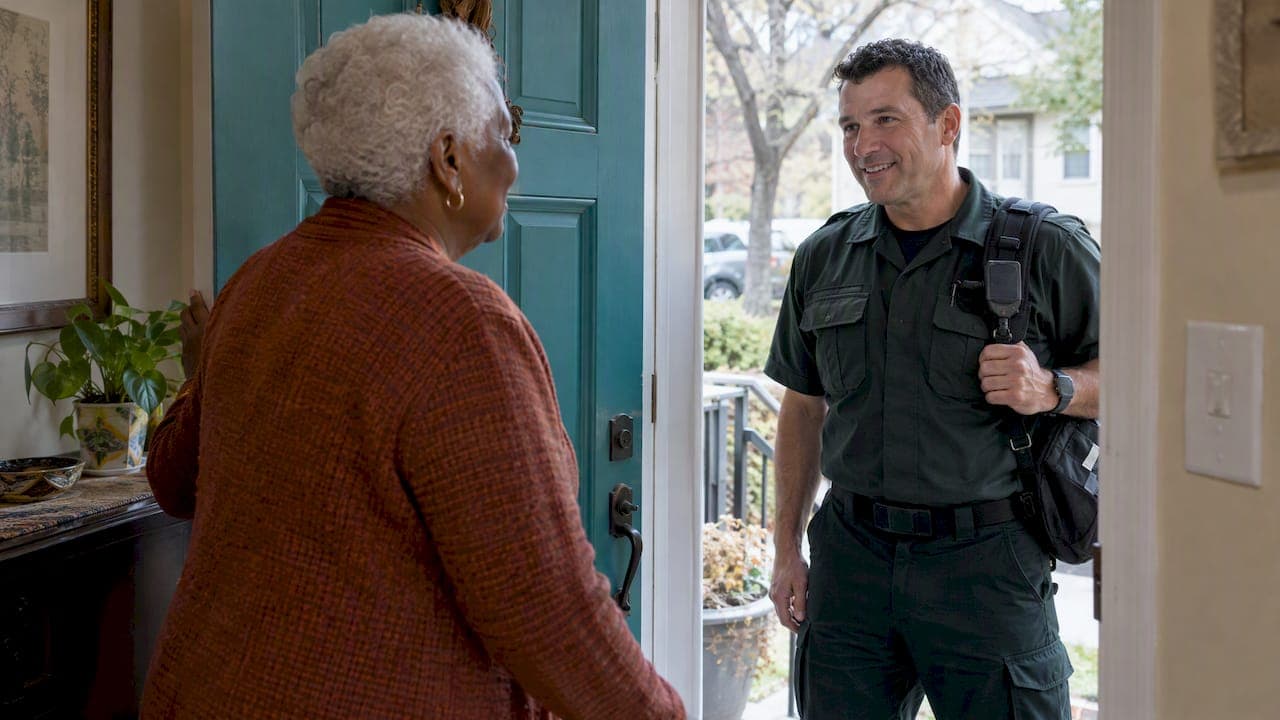
Picture a Tuesday morning. You've made your coffee, the radio is on low, and there's a knock. It isn't a delivery or a salesperson. It's a paramedic you've met before, who sits at your kitchen table, asks how the new blood pressure pills are going, and stays long enough to hear about your sister's visit. Nobody is rushing you to a hospital. That's the everyday heart of community paramedicine, and for many people living on their own, it turns out to be a surprisingly human kind of care.
If you're 50 or older and live solo, this guide explains what these programs are, what a visit looks like, who they serve, how they're paid for, and how to find out whether one exists where you live. Availability depends on where you are, so we'll also show you how to ask.
TL;DR
- Community paramedicine sends trained EMS clinicians to your home or neighborhood for primary and preventive care, post-discharge follow-up, health coaching and care coordination, not just emergencies.
- Programs differ a lot by state and town. Some are free to residents, others rely on grants, hospital partnerships or insurance.
- You usually get in through a referral from your doctor or directly from the local ambulance service or fire department.
- It's a way to have a familiar face in your corner, which is a good fit for a life you want to keep running on your own terms.
- A visit is never a substitute for 911 when something is truly urgent.
Table of Contents
- What community paramedicine actually is
- What a visit can look like
- Who these programs serve
- Where the programs are, and why they differ so much
- How to find out whether one serves you
- What it costs, and who pays
- When it's 911, not a visit
- Our perspective
- Fitting a visit into the life you already love
- Talking it through with us
- A fuller week, one visit at a time
- FAQ
- Sources
What community paramedicine actually is
Most of us picture paramedics one way: lights, sirens, a stretcher. Community paramedicine widens that picture. According to the National Conference of State Legislatures, it connects people with non-urgent needs to primary and preventive care, expanding the role of EMS clinicians beyond stabilizing someone in crisis and transporting them for emergency treatment.
Think of it as the same skills, used earlier and more gently. A paramedic is trained to assess people quickly, notice what's off and know what to do about it. In a community program, that attention gets pointed at the weeks before something goes wrong, and at the weeks after you come home from the hospital.
You may also see the phrase Mobile Integrated Healthcare, or MIH. The Rural Health Information Hub explains that MIH is the broader term: community paramedicine involves only EMS personnel, while MIH may bring in nurses, social workers and other providers. In practice, many local programs use both labels, sometimes in the same brochure.
How it differs from a 911 call
A 911 response is built for the moment something goes wrong. A community paramedicine visit is scheduled, relationship-based and unhurried. You know who is coming. They know your medicines, your steps, your kitchen. That familiarity is the point, and the CDC notes that community paramedics have built trust and acceptance within their communities and can operate at all hours.
What a visit can look like
Every program sets its own menu, but the CDC describes the core services as primary and preventive care, post-discharge care, health education and coaching, chronic disease management, personalized in-home care, and coordination with clinical and nonclinical providers.
Translated into a real morning, that might mean:
- Going through your pill bottles with someone who can spot doubles, gaps or things that don't mix. The Coral Springs, Florida program lists medication reconciliation, home safety evaluations and fall-risk assessments among its visit options.
- Checking in after a hospital stay, when the first week back can feel oddly quiet and uncertain.
- Helping you understand a new diagnosis in plain words, and what to ask at your next appointment.
- Connecting you to a ride, a meal program, a pharmacy delivery or a social group, because health is rarely only about health.
A small, honest detail: the best visits are often half medical and half conversation. When you live alone, a regular, kind, professional hour can be a bright spot in the week. Many solo agers tell us the quiet gets heavier after an illness, and a familiar visitor lightens it.
Who these programs serve
There's no single national rule. Programs set their own criteria, but the groups they look for tend to be similar. Coral Springs describes its program as serving frequent 911 or EMS users, people with limited access to healthcare, and people recently discharged from hospitals.
If you're an independent adult who rarely calls anyone, that may sound like it isn't about you. It can be. A few situations where a program is worth asking about:
- You've just come home from the hospital and your support at home is thin or nonexistent.
- You manage several medicines or a condition like diabetes, heart failure or COPD.
- You live far from a clinic, or driving is getting harder.
- You've had a scare, a fall or an ER visit and want help staying steady.
You don't have to be struggling to qualify for interest. Some programs are narrower, though. A rural program may focus on chronic disease, while a city fire department may focus on repeat callers. That's why a short phone call matters.
Where the programs are, and why they differ so much
Community paramedicine grew out of local need, and it still looks local. Rural areas where the nearest clinic is an hour away have been a natural home for it, but suburbs and cities run programs too. Texas, Maine, Ohio and Florida all have examples among the pages that show up when you search.
The variation is built in. State policymakers decide scope of practice, training requirements and coverage models, so one state may certify community paramedics formally while another leaves it to local agencies. NCSL also notes that states set education, training, licensure, certification and scope-of-practice rules, which is why a program in one county may look nothing like the one two states over.
Rhode Island's state guidebook gives a sense of how a well-run program is meant to start: it should address community health needs identified through a needs assessment and coordinate with other healthcare systems. In other words, a good program is built around what the neighborhood actually needs, not copied from somewhere else.
Programs sit inside a bigger web of support
Mobile integrated health is, at heart, about linking different kinds of help. Paramedics may work alongside nurses, social workers, clinics and daytime programs. For families and friends who also look after someone with memory loss, this web can include options such as adult day care for older adults with dementia, which gives the person structure and company while giving caregivers a breather. A community paramedic who knows your whole picture is often the one who can point you to that kind of help.

How to find out whether one serves you
There's no national directory that's complete, so you go local. A few routes that tend to work:
- Ask your primary care office. Many programs take referrals from doctors, and your clinic may already work with one.
- Call the non-emergency line of your local fire department or ambulance service. Ask, "Do you have a community paramedic or home visit program?"
- Ask the hospital discharge planner before you go home from a stay, if that's where you are.
- Try your Area Agency on Aging. They know what's offered nearby, and they can usually point you to the right door.
Here's one real example of how it works. United Ambulance in Maine runs a home visit program, also called community paramedicine. You request a referral form from your primary care provider or United Ambulance, return it to their Prevention & Wellness Office, and the office contacts you to schedule a visit. Other places will have different paperwork, but the shape is usually the same: a form, a call, a scheduled visit.
When you call, a couple of questions help: Who is eligible? Is there a cost? How often do visits happen? Can I choose a time? Who will actually be coming?
What it costs, and who pays
This is where it gets honestly uneven. The Rural Health Information Hub reports that funding varies, and many programs rely on in-kind or financial support from ambulance services, hospitals or grants, while some private insurers are beginning to consider reimbursement. Some programs cost you nothing. The Coral Springs-Parkland Fire Department, for example, does not bill for visits or services.
On the insurance side:
- Medicaid and private insurance: coverage and payment vary greatly from state to state. A federal payment experiment, the ET3 model, concluded on December 31, 2023, though states continue to adapt its ideas.
- Medicare: Part B covers community health integration services, including care coordination, health system navigation, and social and emotional support for nonmedical factors that affect your health or access to care. That isn't the same as a paramedic home visit, but it shows Medicare is paying attention to this kind of whole-person help. Ask your own plan what it covers.
- Grants: federal HRSA grants support rural health programs and those serving underserved populations, which is part of how many local programs stay afloat.
The short version: ask the program directly what you'd owe, and ask your insurer or Medicaid office if the answer isn't "nothing."
When it's 911, not a visit
A community paramedic is a planned partner, not an emergency line. Chest pain, trouble breathing, signs of a stroke, a serious fall or sudden confusion are 911 situations, every time. Your visiting paramedic will likely tell you the same thing and help you think through what counts. Knowing that, you can relax into the ordinary visits, which is the whole idea.
Our perspective
When we talk with solo agers, the story we hear most isn't about disaster. It's about the small, steady things: who notices if I'm off this week, who knows what pills I take, who I can ask a simple question without feeling like a burden.
Community paramedicine answers some of that in a very human way. A professional shows up, knows your name, and treats your home as a place where a good life is happening, not a problem to manage. We think that fits what Aging Solo Today stands for: independence that's supported, and connection that's real.
Programs won't be everywhere, and they won't solve everything. That's why we pair them with something you build yourself: friends, neighbors, a doctor who listens, and a plan that's yours. Our Circle of Care page and our Build Your Support Circle guide are about exactly this. A paramedic visit can be one warm thread in a larger fabric, and we'd love to help you weave the rest.
Mike Crawford
Fitting a visit into the life you already love
It's worth saying plainly: asking for a visit isn't giving up anything. People who garden, travel, volunteer, date and host Sunday dinners also take their pills and see their doctors. A home visit can simply be the quiet backstage that lets the front of the stage stay lively.
A few ideas that tend to feel good in practice:
- Make it a rhythm. If a program offers monthly visits, put them on the calendar next to your walking group or your book club. It becomes part of your week, not a special event.
- Invite a friend to sit in. Having a trusted person hear what the paramedic says builds your circle, and it gives someone else a clearer sense of how to show up for you. If you're thinking about how friends can help, our piece on paying a friend as your caregiver is worth a look.
- Ask about rides and connection, not only medicine. Transportation is often the thing that quietly shrinks a life. Our guides to non-emergency medical transportation and paratransit eligibility can help you keep your world wide.
If your town has a regular friendly phone call service, that can be a lovely companion to home visits too. See how calls programs for older adults work, and how people join or volunteer.
Talking it through with us
Some people read a guide like this and still wonder, "What would this look like for me?" That's a fair question, and a personal one. Our Solo Aging Clarity Session is a 45-minute Zoom conversation for $97, one time, where we talk through your situation, your goals and the supports you'd like around you.
If you'd like a conversation, book a Solo Aging Clarity Session. If you'd rather explore on your own first, our free Support for Older Adults planning guide is a gentle place to start.
A fuller week, one visit at a time
Community paramedicine won't be in every town, and it isn't meant to be everything. But where it exists, it offers something that's easy to underestimate: someone knowledgeable who comes to you, remembers you and cares how your week is going. Alone doesn't have to mean on your own for every single thing.
So make the call. Ask the question. Then go back to your coffee, your garden, your plans for the weekend, and your own good company.
FAQ
What is community paramedicine in simple terms?
It's care delivered by trained EMS clinicians outside the emergency setting, usually at your home or in your neighborhood. Instead of only responding to crises, they help with preventive care, follow-up after hospital stays, health coaching and connecting you to other services. It's planned, not urgent.
Is community paramedicine the same as mobile integrated health?
They overlap but aren't identical. Community paramedicine uses EMS personnel, while mobile integrated healthcare can add nurses, social workers and other providers. Many local programs use the terms loosely, so just ask what the program offers.
Do I have to pay for a visit?
It depends on where you live. Some programs, like Coral Springs-Parkland's, don't bill for visits, while payment elsewhere may come from grants, hospitals or insurance. Ask the program directly, and check with your insurer or state Medicaid office.
How do I sign up?
Start with your primary care provider or your local ambulance service or fire department. Many programs use a referral form, then call you to schedule, as United Ambulance's home visit program does. If you don't find one, your Area Agency on Aging can point you to nearby help.
Can I use it if I'm healthy and just live alone?
Possibly, but programs set their own rules. Many focus on people recently discharged, frequent EMS users, or those with limited healthcare access. A call to ask costs nothing and tells you what's available.
Sources
- State Definitions and Coverage of Community Paramedicine (NCSL)
- Community Paramedics (NCSL)
- The Value of Community Paramedicine (CDC)
- Community Paramedicine and Mobile Integrated Healthcare (Rural Health Information Hub)
- Rural Community Paramedicine Toolkit (Rural Health Information Hub)
- Community Paramedic Program (City of Coral Springs)
- Home Visit Program (United Ambulance Service)
- Mobile Integrated Health-Community Paramedicine Guidebook (Rhode Island Department of Health)
- Community Health Integration Services (Medicare.gov)
- Adult day care for older adults with dementia (Clubhouse Life)