
Picture a Tuesday morning at the farmers market. You have a bag of peaches in one hand, a good coffee in the other, and you are halfway through a conversation with the woman who sells the honey. Then the world tilts. You sit down on a crate, someone calls for help, and a kind stranger asks, "Is there anyone we can call for you?"
That question lands differently when you live alone. It isn't a tragedy. It's just a moment where you'd like the answer to be ready, so you can go back to being a person with peaches instead of a puzzle for strangers.
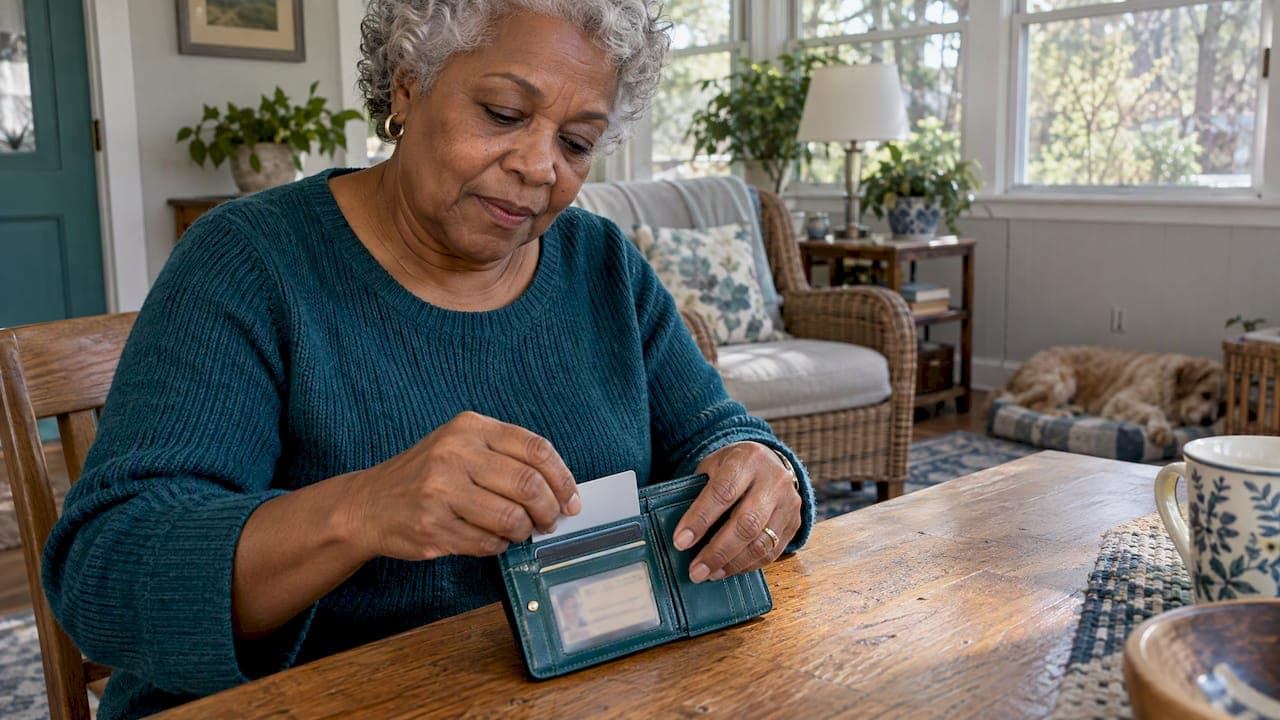
An emergency wallet card is that answer, written in advance, small enough to slip behind your driver's license. It lists who you are, who to call, and the health details a stranger would otherwise have to guess. Making one takes about twenty minutes, and it can give you a quiet kind of freedom: the confidence to go out, linger, travel and say yes to things.
TL;DR
- An emergency wallet card (often called an ICE card, for "in case of emergency") tells medical staff who you are and who to call when you can't say so yourself.
- Keep it to the essentials: your name, birth date, emergency contacts, medical conditions, allergies and medications with doses and timing.
- Carry it in your wallet behind your ID, and also put an "ICE" contact in your phone. Neither one replaces the other.
- A card is most useful once you reach the emergency room, so pair it with other places where your information can be found.
- Review it a couple of times a year. A card with an old phone number is worse than a bare one.
Table of Contents
- What an emergency wallet card actually does
- What to put on your card
- What to leave off
- Where to carry it so it gets found
- Be honest about what a card can't do
- How to make one in an evening
- Keeping it current without making it a chore
- Our perspective
- If you'd like a second pair of eyes
- Back to the peaches
- FAQ
- Sources
What an emergency wallet card actually does
Think of it as a short introduction you carry for yourself. UPMC explains that ICE information, on a phone or in a wallet, can help emergency staff identify you, reach someone who can speak on your behalf, and learn about health conditions or medical issues.
When you live with a partner or grown children, someone usually fills in those blanks without thinking. When you live alone, or are aging without children nearby, the card does that job. It carries your voice into a room where you can't use it.
It's also a gentle thing to hand to a friend. Some people we know of make two, one for themselves and one for the friend they've traded cards with. That small exchange says, "You matter enough that I've written down your number."
What to put on your card
You don't need a long form. Connecticut's Department of Public Health, in its emergency health information card guidance, says a card should include your name, address, birth date, blood type and emergency contacts. It should also list medical conditions, allergies, current medications with dosage and timing, and any equipment or communication needs.
The CDC's version is simpler still. Its family preparedness card asks for your name, date of birth, home phone, emergency and out-of-town contacts with phone numbers, and special needs, medical conditions, allergies and other important information.
Here is how that looks in practice, laid out as a quick reference:
| Section | What to write | A real-life example |
|---|---|---|
| You | Full name, birth date, home address | Margaret L. Ortiz, born 3/14/1951 |
| Contacts | Two people, with relationship and phone | Dana (neighbor), Ruth (friend, out of town) |
| Health | Conditions that change how you're treated | Type 2 diabetes, pacemaker |
| Allergies | Medicines and anything else serious | Penicillin |
| Medications | Name, dose, when you take it | Metformin 500 mg, twice daily |
| Needs | Equipment or communication needs | Hearing aids, wears glasses |
If you want more room for a long medication list, our guide to a medication list card compares free templates with a sturdier wallet version.
Choosing the people you name
This is the part that takes some thought, and it's the part that tends to feel tender. Who do you put down when you don't have a spouse or children?
A few ideas that work for the people we hear from:
- A neighbor who is usually home and has a key or knows where one is.
- A friend in a different city, so that one local storm doesn't take out both contacts.
- A longtime friend who simply knows you well and will stay calm on the phone.
Ask first. Saying "Would you be my emergency contact? I'd be yours" often turns into one of the warmest conversations of the month. People tend to be honored, not burdened. Our piece on why seniors should update emergency contacts annually goes deeper on keeping those relationships current.
If you also manage a house, a rental or a second property, the same habit of writing down who to call applies to your home. This guide to emergency home contacts shows how some owners organize the repair and service numbers they would want ready.
What to leave off
A wallet can be lost, and a card is read by strangers. So the rule we like is: write what a paramedic or nurse needs, and nothing a thief would enjoy.
Some printed templates, including the Connecticut one, have lines for a Social Security number and health insurance carrier and policy numbers. That's the template's choice. Our own view is that you can skip the Social Security number entirely, because emergency staff don't need it to treat you and it's the one number you least want to lose in a dropped wallet. Your insurance card already lives in your wallet anyway.
Also skip:
- Bank or credit card details.
- Door codes, alarm codes or passwords.
- Long medical history. Keep it to what changes treatment today.
- Anything you wouldn't want read aloud in a waiting room.
Meaning: your card should read like a good first-day introduction, not a biography.
Where to carry it so it gets found
The best card is useless in a drawer at home. The Connecticut guidance suggests keeping copies in your wallet or purse behind your driver's license or primary ID, and also in your car, at work, in emergency supply kits and in carry-with-you kits.
The wallet spot is the one that matters most. Behind the license means anyone who looks for your ID will find it too.
A few other habits help:
- Put an ICE contact in your phone. The FCC and FEMA suggest storing at least one emergency contact in your phone under "In Case of Emergency" or "ICE."
- Use your phone's built-in health features. If you carry an iPhone, our walk-through on setting up iPhone Medical ID takes a few minutes. Android owners can see how to set up emergency info and who to name.
- Keep a spare card in your car or travel bag. It's the one you'll forget about until you need it, which is exactly the point.
Be honest about what a card can't do
Here's the part some product pages skip. According to Verywell Health, wallet cards are most helpful to medical professionals after you reach the emergency room, and they aren't the first place most emergency responders look.
That doesn't make the card pointless. It means it's one layer, not the whole picture. A card in the ER can save a nurse twenty minutes of guessing about your medications. It just isn't what a first responder checks at your kitchen door.
That's why many people add a second spot at home. In the UK, Norfolk County Council describes a Message in a Bottle form kept in the fridge, so emergency services can quickly find personal, contact and medical details. It's a British scheme, but the idea travels well: a fridge is a place everyone knows to open. Our guide to a digital, wallet and fridge contact plan shows how to line the three up so they say the same thing.
A broader plan can also hold utility company numbers, veterinarian contacts, and local and out-of-town meeting places, as the Ready.gov family communication cards suggest. If you have a dog who would be waiting at home, the vet's number and a neighbor who knows to check in belong somewhere written down.

How to make one in an evening
You don't need to buy anything. Ready.gov offers a wallet-format communication plan that folds to wallet size, and plenty of free tools let you type and print one. You can also write it by hand on an index card in clear block letters, then cover it with clear tape.
Try this version: make a cup of tea, sit somewhere comfortable, and fill the card as if you're introducing yourself to a kind, busy stranger. Then text your two contacts to tell them they're on it. That text is also a lovely little moment of connection.
When it's done, slide it behind your license and go back to your day.
Keeping it current without making it a chore
Cards go stale in quiet ways. A neighbor moves. A prescription changes. A phone number gets swapped.
The easiest fix is to pin the review to something you already do. Many people choose their birthday and the start of daylight saving time, so it happens twice a year without a reminder. When the dose on a medication changes, update the card the same day, since that's the line a nurse is most likely to rely on.
If you want a calmer way to think through the "what if" moments, our piece on home emergency drills for seniors is about rehearsing with confidence rather than worry.
Our perspective
We started Aging Solo Today because living on your own can be a full, funny, adventurous life, and because we've seen how much easier it is to enjoy that life when the practical bits are quietly handled.
The wallet card is a perfect example. It isn't a statement that something is wrong. It's the opposite: it's what lets you stay out late at the concert, take the train to see a friend, or try the new place down the street where you'll eat dinner alone and love it. A small thing in your wallet is what makes the big thing, the unhurried life you're building, feel steady.
We also think the card works best when it's tied to real people. The names on it should belong to friends who know they're on it, who've had coffee with you and who'd pick up on the second ring. The paper is the easy part. The circle is the gift.
— Mike Crawford
If you'd like a second pair of eyes
Some people finish their card and then wonder about the bigger picture: who else should know what, and how all of it fits together. Our Solo Aging Clarity Session is a 45-minute Zoom conversation for exactly that, for $97, one time. It's a chance to talk through your own situation with someone who gets what solo aging feels like.
If you'd rather start on your own, our free checklists and resources are there for you, no purchase needed.
Back to the peaches
Go back to that farmers market for a second. This time, when the stranger asks who they can call, they find a small card behind your license. Within a minute, Dana is on the phone, and someone is telling the nurse about your allergy before you can even worry about it.
Then, a few weeks later, you're back at the honey stand with a fresh coffee, telling that story and laughing about it.
That's what the card is really for. It's less about the emergency than about everything you get to keep doing: the market mornings, the long dinners, the trips you haven't taken yet. A life lived solo can be wide open, and now a small piece of paper helps hold the door.
FAQ
What is an ICE wallet card?
ICE stands for "in case of emergency." It's a small card in your wallet with your name, emergency contacts and key health details. Emergency staff can use it to identify you and reach someone who can speak for you.
Is a wallet card or a phone entry better?
Use both. A phone entry labeled "ICE" is quick to find, but phones can be locked or dead. A wallet card works without power and sits behind your ID, where people look for who you are.
How many emergency contacts should I list?
Two is a good number for most people. Choose one who lives nearby and one in a different area, so at least one is likely to be reachable. Ask each person ahead of time so a call doesn't come as a surprise.
Should I put my medications on the card?
Yes, if you take any regularly. List the name, dose and when you take it, since that's what medical teams need to know first. If your list is long, write the most important ones and note where the full list is kept.
How often should I update the card?
Review it at least twice a year, and any time a medication, doctor or contact changes. Tying it to your birthday and a seasonal clock change makes it easy to remember.
Sources
- In Case of Emergency (ICE), UPMC Emergency Medicine
- Creating an Emergency Health Information Card, Connecticut Department of Public Health
- Prepare for Everywhere: Family Preparedness, CDC
- Family Communication Plan Cards, Ready.gov
- Tips for Communicating During an Emergency, FCC and FEMA
- Where to Keep Medical Information for Emergencies, Verywell Health
- Make important information easy to find, Norfolk County Council